No products in the basket.
Vans that stop on roads for works or inspection purposes may need Chapter 8 markings, particularly when operating on high-speed roads. However, the answer depends on what the vehicle does, where it stops and the requirements set by the organisation responsible for the work.
Chapter 8 markings for vans are intended to make working vehicles more conspicuous to approaching traffic. They are especially important when a van is stationary, moving slowly or forming part of a temporary traffic-management arrangement.
Not every business van needs rear chevrons simply because it travels on public roads. A van used to transport a tradesperson to a private property is in a different situation from a utility vehicle that stops beside live traffic while its crew inspects or repairs roadside infrastructure.
Fleet operators should therefore assess the vehicle’s duties rather than relying on a broad description such as “commercial van” or “work vehicle”.
What is Chapter 8?
Chapter 8 forms part of the UK Traffic Signs Manual. It provides detailed guidance on traffic-safety measures and signs for road works and temporary situations.
The Department for Transport’s official Traffic Signs Manual explains that Chapter 8 is divided into different parts. Part 1 addresses the design of temporary traffic-management arrangements, while Part 2 covers the planning, implementation, maintenance and removal of those arrangements.
The guidance applies to activities involving road works, temporary closures, maintenance and inspections. Its purpose is to establish consistent working practices that help protect road users and people working on or near the highway.
Chapter 8 covers much more than vehicle chevrons. It also addresses subjects including:
Vehicle markings are one part of this wider system. Fitting chevrons does not, by itself, make an entire road-working operation compliant or safe.
Are Chapter 8 markings a legal requirement?
Chapter 8 is often described as though it were a piece of legislation, but that is not entirely accurate.
The manual states that Chapter 8 is a code of practice intended to help organisations meet legal requirements across a wide variety of working situations. In Great Britain, it generally does not have statutory force in its own right. Different provisions apply in Northern Ireland, where it may have statutory force for certain roads and traffic-management devices.
This does not mean that businesses can simply ignore the guidance. Employers, contractors and people responsible for road works still have legal duties relating to health and safety, traffic signs, safe working systems and the proper guarding of works.
The manual also recommends that authorities and organisations responsible for roads to which the public has access make Chapter 8 compliance a condition of contracts awarded on their behalf. As a result, markings can become a firm contractual requirement even where Chapter 8 itself is not standalone legislation.
Requirements may arise through:
The practical question is therefore not only, “Is Chapter 8 a law?” It is also, “What duties and contract conditions apply to this vehicle and its work?”
Which vans are most likely to need Chapter 8 markings?
Chapter 8 markings are particularly relevant when a van stops on the highway for works or inspections, protects a workforce or contributes to the signing of a work area.
Examples can include vans used by:
The business sector alone does not determine whether markings are needed. Two vans belonging to the same company may perform very different roles.
For example, an office support van that travels directly into a secure compound may not face the same requirements as a maintenance van that regularly stops on a grass verge, hard shoulder or carriageway. The operational risk is different even if both vehicles carry the same company branding.
Do vans need chevrons when working on high-speed roads?
Chapter 8 gives particular attention to vehicles stopping on high-speed roads for works or inspections. Within the manual, a high-speed road is defined as a single or dual carriageway with a permanent speed limit of 50 mph or more.
For these situations, the guidance says that vehicles stopping on the highway for works or inspection purposes should be equipped with high-visibility rear markings.
This is understandable because approaching drivers have less time to recognise and react to a stationary or slow-moving vehicle at higher speeds. A van that is easily visible in a depot or urban car park may be much harder to identify at a distance in rain, darkness or road spray.
The recommended rear-marking options include chevron markings made from alternating fluorescent and reflective materials. The markings should cover as much of the rear-facing area as reasonably possible without obscuring:
Suitable Chapter 8 chevrons help approaching drivers recognise the rear of a working vehicle earlier, particularly where contrast and visibility might otherwise be poor.
What about vans working on lower-speed roads?
Lower speeds do not remove the need to consider vehicle visibility.
Chapter 8 states that vehicles used for works or inspections on all classes and speeds of road should be conspicuous. The exact arrangement may differ according to the road, the work, the duration of the stop and the traffic-management measures already in place.
An urban road can still present serious risks. A van may be partially hidden by parked vehicles, positioned after a bend or exposed to buses, cyclists and pedestrians. Poor weather, darkness and restricted sight lines can make a relatively low-speed location hazardous.
The risk assessment should consider:
A lower speed limit should not be used as the sole reason for leaving a working vehicle unmarked. The appropriate markings should be determined as part of the complete safe system of work.
Do vans simply travelling on roads need Chapter 8 markings?
A van does not normally need Chapter 8 markings merely because it is driven on public roads.
The guidance is primarily concerned with vehicles involved in road works, inspections and temporary traffic-management operations. A delivery van, plumber’s van or electrician’s van travelling normally with other traffic is not automatically a Chapter 8 vehicle.
The position may change if that van stops on or near the highway to carry out work. For example, a contractor may usually work inside commercial premises but occasionally need to inspect equipment positioned beside a busy road.
Fleet operators should consider the most demanding regular use of the vehicle. If roadside activity is foreseeable rather than exceptional, suitable markings and safety equipment should be planned before the van is sent to the location.
Workers should not be expected to improvise a visibility solution after arriving at a live-road environment.
What should Chapter 8 rear markings look like?
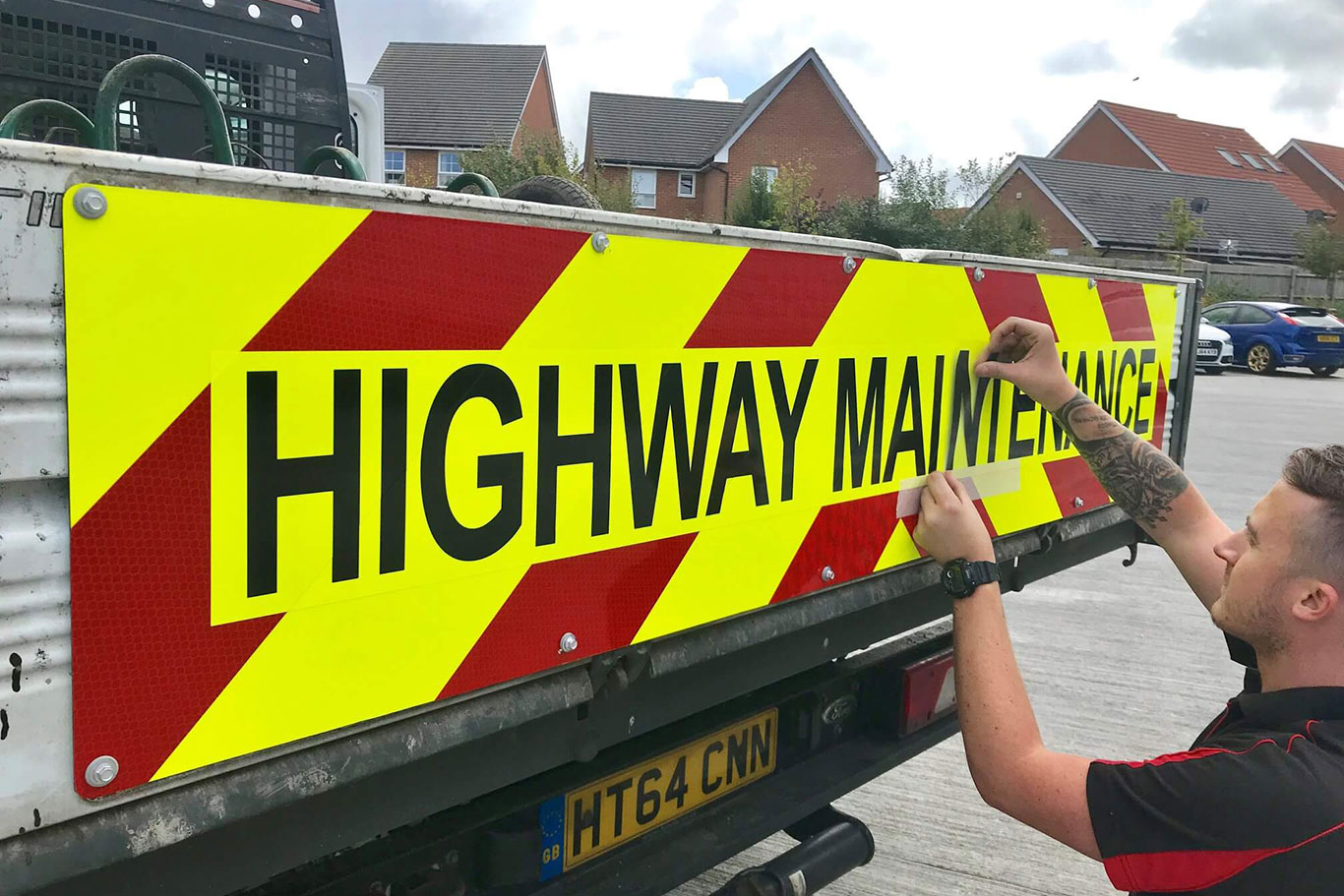
A commonly used Chapter 8-style rear treatment consists of alternating fluorescent yellow and orange-red reflective chevrons. The stripes point upwards towards the centre of the vehicle, creating a clear pattern for drivers approaching from behind.
According to the operational guidance, the chevron strips should be at least 150 mm wide and inclined between 45 and 60 degrees. The markings should cover as much of the suitable rear-facing portion of the vehicle as possible without obstructing windows, lights or the registration plate.
The specific material construction is important. A pattern that merely uses similar colours is not necessarily suitable. Decorative yellow and red vinyl may resemble road-working chevrons during daylight but provide little or no useful reflection when illuminated by headlights.
An appropriate kit should be selected according to:
Vehicle-specific chevron kits can make it easier to achieve a consistent layout around hinges, handles, lights and number plates.
Are chevrons the only markings a road-working van needs?
No. Rear chevrons are only one part of a road-working vehicle’s visibility and identification requirements.
Depending on the role, the vehicle may also need:
The required equipment varies according to the vehicle’s function. An inspection or supervisor vehicle may have a different specification from a traffic-management equipment carrier or impact-protection vehicle.
Operators should not assume that fitting a rear chevron kit completes every requirement. The full vehicle specification should be checked against the work plan, applicable guidance and contract conditions.
Does an amber beacon replace rear chevrons?
No. An amber beacon and rear chevrons serve related but different purposes.
A beacon attracts attention and signals that a vehicle may be moving slowly, entering a work area or presenting an unusual hazard. Rear chevrons help define the vehicle’s position and make its rear surface more conspicuous, particularly when illuminated by approaching headlights.
A beacon can also be obscured by equipment, roof racks or the viewing angle. Conversely, dirty or damaged rear markings may lose much of their effectiveness. Using the required equipment together provides a more complete visibility system.
The beacon must also be used appropriately. Simply having one fitted to the roof does not help if it is not operational, cannot be seen or is not activated when required.
Who decides whether a van needs Chapter 8 markings?
The decision should form part of the planning and risk-assessment process for the work. Responsibility may involve several parties, including:
The driver should be given a vehicle that is suitable for the assigned task. They should also know how to check the markings, lights and safety equipment before setting out.
If a client contract specifies Chapter 8-compliant vehicles, the fleet manager should confirm exactly what standard is expected. A vague instruction to “put chevrons on the van” may overlook other equipment, material and coverage requirements.
Can a marked van become unsuitable over time?
Yes. Vehicle visibility must be maintained, not treated as a one-off installation task.
Reflective and fluorescent materials can become dirty, damaged, faded or partially detached. Road salt, mud, pressure washing, sunlight, chemical cleaners and everyday impacts can all affect the condition of the markings.
A vehicle may also be modified after its kit is fitted. New ladder racks, towing equipment, tail lifts or storage accessories could obscure part of the pattern.
Routine checks should look for:
Chapter 8 specifically advises that works vehicles should be kept clean to maintain conspicuity. A technically correct kit cannot perform properly if it is hidden beneath road dirt.
What happens if a road-working van does not have suitable markings?
The consequences depend on the situation and the requirements that apply to the work.
An unsuitable vehicle may be refused access to a project, rejected during a fleet inspection or found to breach a client’s contract conditions. Work could be delayed while a replacement vehicle is arranged.
More importantly, poor vehicle visibility can increase the risk to road users and workers. If an incident occurs, investigators may examine the organisation’s risk assessment, vehicle specification, maintenance records and adherence to recognised industry guidance.
Possible consequences include:
Treating vehicle markings as an optional cosmetic feature fails to recognise their safety purpose.
Frequently Asked Questions
Do motorway maintenance vans need Chapter 8 markings?
Vans stopping on motorways for works or inspections should meet the relevant Chapter 8 vehicle and visibility guidance. The required specification may include rear markings, a maintenance sign, amber warning lights and other equipment appropriate to the vehicle’s role.
Does a van need chevrons if it only works on residential streets?
Not automatically, but the vehicle’s visibility should still be assessed. The work location, traffic conditions, stopping position, duration and client requirements all matter. Chapter 8 recommends conspicuous vehicles for works and inspections across all road classes.
Are red and yellow stickers automatically Chapter 8 compliant?
No. Similar colours alone do not establish compliance. The material type, reflective performance, stripe dimensions, layout, coverage and condition all need to be suitable.
Can company branding be displayed with Chapter 8 markings?
Company identification can be included, provided it does not obscure or reduce the effectiveness of the required safety markings. A planned custom layout may be preferable to adding logos after the chevrons have been fitted.
Do parked works vans need their beacons switched on?
The correct use of a beacon depends on the road, stopping position and traffic-management arrangement. Chapter 8 includes circumstances in which roof-mounted amber beacons should remain in use, including certain stops on hard shoulders or carriageways.
Do self-employed contractors need Chapter 8 markings?
Being self-employed does not remove the need to work safely or comply with applicable site and contract rules. A self-employed contractor whose vehicle stops on the highway for works should assess the same operational risks as a larger fleet.
Is Chapter 8 compliance checked during an MOT?
An MOT is not a complete Chapter 8 compliance inspection. Passing an MOT does not confirm that a van has the correct markings or equipment for road-working duties.
Can temporary magnetic chevrons be used?
Any temporary marking solution would need to remain secure, visible and appropriate throughout the work. Fleet operators should verify that it meets the relevant specification and contract requirements rather than assuming that a removable pattern is sufficient.
Vans working on roads may need Chapter 8 markings when they stop on the highway for works or inspections, particularly on roads with speed limits of 50 mph or more. However, the correct vehicle specification depends on the actual task, road environment, risk assessment and contractual requirements.
Rear chevrons should be treated as part of a complete visibility and traffic-management system. They work alongside suitable vehicle positioning, warning lights, maintenance signs, clean surfaces and safe working procedures.
If you are preparing a van for road, utility or highway work, confirm the applicable specification before ordering. All About Chevrons supplies vehicle-specific safety markings for commercial fleets and individual work vehicles. For help identifying an appropriate kit, contact the team.
Phone: 023 9252 0333
Email: info@allaboutchevrons.com
Find out more: All About Chevrons